2025-04-02
WASHINGTON (AP) — Weak population gains and increased government spending will result in slower overall economic growth over the next 30 years, the nonpartisan Congressional Budget Office said Thursday.
The CBO’s latest long-term budget and economic outlook report — for a timeframe that spans 2025 to 2055 — projects publicly held debt to reach 156% of gross domestic product, or GDP, in 2055. That’s down from the agency’s March 2024 long-term budget projection, which said publicly held debt would be equal to a record 166% of American economic activity by 2054.
However, that’s not necessarily a positive.
The mix of slower population growth and unfettered spending will also result in weaker economic growth over the next three decades than what the CBO projected last year. Lower birthrates also mean that the United States is becoming more dependent on immigrants working to sustain growth.
“Without immigration, the U.S. population would begin to shrink in 2033,” the CBO report states.
The report assumes that all the laws set to expire, including certain provisions of Trump’s 2017 tax cuts, will expire. But the White House and Republican lawmakers have said that the tax cuts will be renewed and potentially expanded, as well as suggesting reductions in government spending and an increase in revenues by taxing imports.
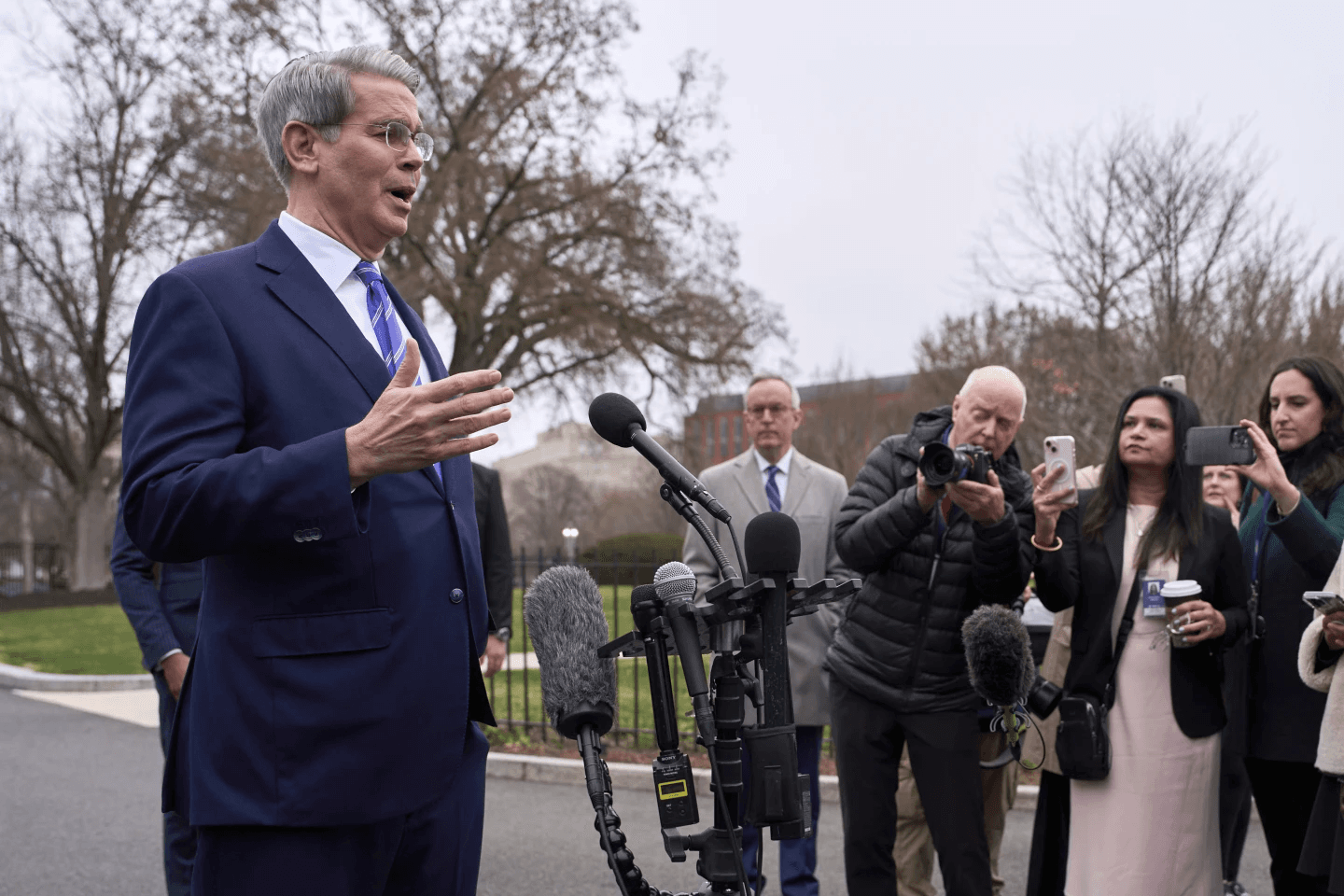
Still, the report’s warnings and its projections for the future also set the stage for the challenges on the debt, government spending and economic growth that Treasury Secretary Scott Bessent insists the Trump administration can fix.
Bessent has advocated for a “3-3-3” plan, which involves getting the federal budget deficit down to 3% of GDP, boosting inflation-adjusted annual GDP growth to 3% and producing the equivalent of an additional 3 million barrels of oil per day by 2028.
The treasury secretary has sought to discredit CBO scoring, calling it “crazy.”
“I was in the investment business for 35 years, I thought I understood how crazy CBO scoring is,” Bessent told CNBC earlier this month. “And now that I’m on the other side of the wall, I can tell you it’s really crazy. And very unlikely that we are going to get any credit in the CBO scoring for tariffs.”
However, CBO warnings about population growth cut into Trump administration policy priorities related to mass deportations, as officials claim that immigrants are fueling high inflation by worsening the housing shortage and depriving U.S. citizens of job opportunities.
A decreasing population could have profound negative effects on the economy, as growth depends on adding workers as well as increasing their productivity. Falling population levels could cause a stagnation in living standards and create difficulties in paying down debts as well as funding programs such as Social Security, which is dependent on payroll taxes.
The report also comes as the U.S. is on track to hit its statutory debt ceiling — the so-called X-date when the country runs short of money to pay its bills — as early as August without a deal between Congress and the White House.
The CBO and the Bipartisan Policy Center this week detailed projections for the U.S. to hit its statutory debt ceiling sometime this summer — as soon as July or August, respectively.
Michael Peterson, CEO of the Peter G. Peterson Foundation —which among other things tracks the federal debt— said in a statement that “as bad as this outlook is, it represents an ‘optimistic scenario,’ because policymakers are currently considering adding trillions more in tax cut extensions, which would add to the debt.”
Fundism Limited is registered at Hamchako, Mutsamudu, Autonomous Island of Anjouan, Union of Comoros, and is licensed and regulated by the Securities Commission of the Comoros under license number L15962/FLTD.
Fundism Pty Ltd (ACN 686 857 198, ABN 84686857198) is registered in South Australia, Australia, with its registered address at Level 1, 256 Rundle Street, Adelaide SA 5000. Fundism Pty Ltd provides operational, marketing, and support services and is not the issuer of any products offered on this website.
Fundism operates under the trading name "Fundism." The website, platform, and related services are operated under the Fundism brand. Fundism Limited acts as the contracting entity for trading services. The company's logo, trademark, and website are the exclusive property of Fundism.
Contact: support@fundism.com
Risk Warning: Proprietary trading involves a high level of risk and may not be suitable for all users. Participation in trading activities and simulated or funded trading programs requires specialized knowledge and discipline. Please ensure you fully understand the risks involved and are prepared for potential losses before engaging in any trading activity. Fundism shall not be held liable for any losses, damages, or adverse outcomes resulting from participation in trading programs or use of this website. All information provided on this website is for educational purposes only and does not constitute financial advice. Users should make independent and informed decisions.
Restrictions: Fundism does not direct its website or services to residents of jurisdictions where such activities are prohibited by law, regulation, or policy. If you reside in a jurisdiction where the use of this website or its services is restricted, you are responsible for ensuring compliance with local laws. Fundism does not guarantee that the content of its website is appropriate or lawful in all jurisdictions.
Fundism does not provide services to citizens or residents of certain countries, including (but not limited to): the United States, Brazil, Canada, Israel, and Iran.
